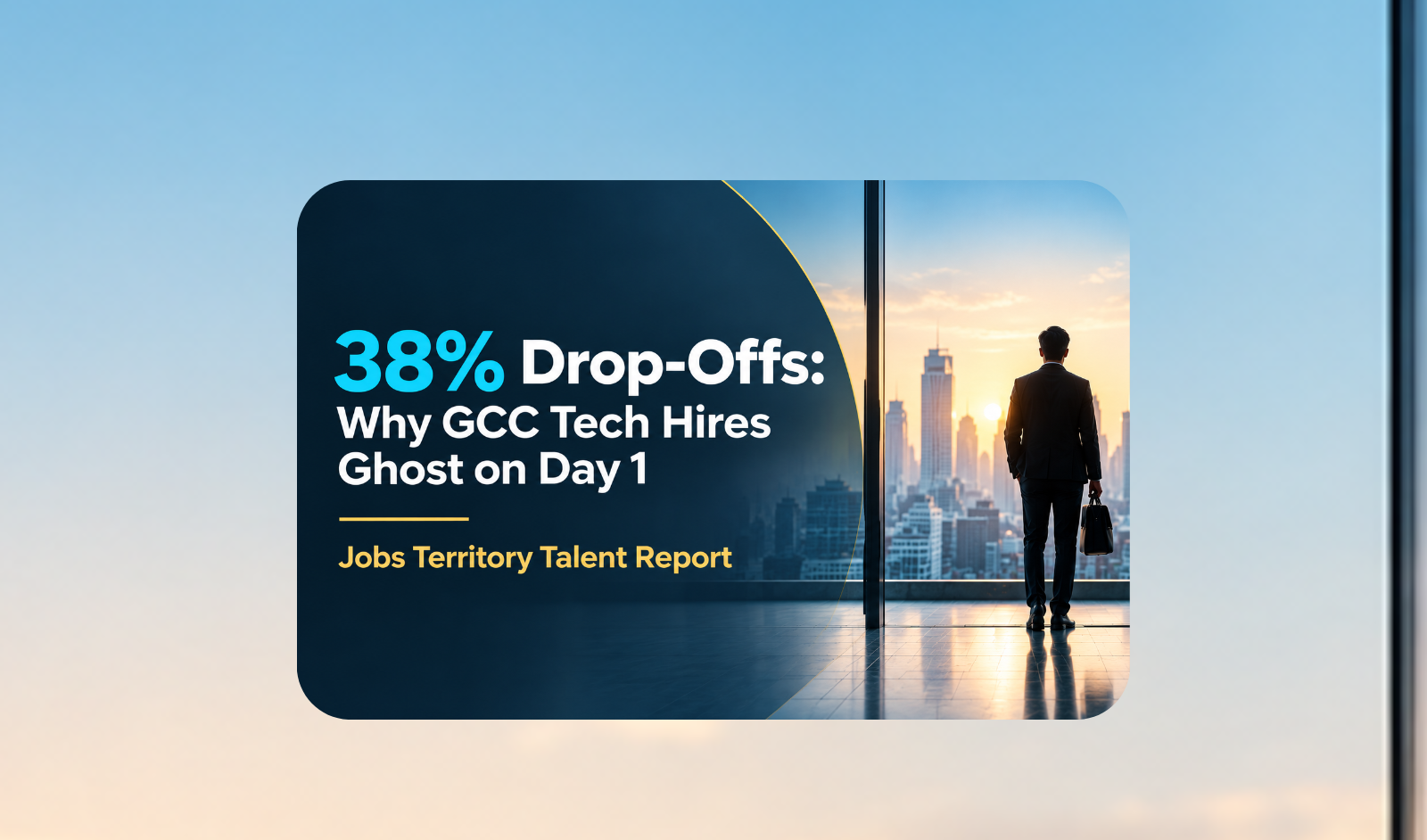
The 70-Day Ghosting Crisis: Why India’s GCCs Are Losing 38% of Top Tech Hires (And How Modern TA Leaders Are Fixing It)
The scenario has played out across executive boardrooms in Bengaluru, Hyderabad, and Pune hundreds of times this year:
An Engineering Vice President spends six weeks evaluating a short-list of elite distributed-systems architects.
The selected candidate formally accepts an offer of ₹48 LPA. The signed acceptance letter is safely filed into the ATS. Everyone breathes a sigh of relief.
Over the next 60 days of the candidate’s mandatory notice period, the talent team sends two polite, automated check-in emails: "Hope your handover is going smoothly!"
Then arrives Day 1.
The laptop is configured. The team is waiting on Slack. The onboarding coordinator has the welcome kit ready.
The phone rings out. The WhatsApp message stays on a single grey tick. The candidate is a no-show.
By afternoon, word spreads: the candidate accepted a last-minute counter-offer from another Global Capability Center (GCC) just two kilometers away—lured by a 10% premium, an attractive signing bonus, and a shinier title.
If you lead Talent Acquisition, Human Resources, or run a GCC in India today, this is not an isolated bad experience. It is an industry-wide retention crisis occurring before employment even starts
The 2026 GCC Boom: Massive Scale Meets Extreme Friction
India is currently the global epicentre of capability expansion, hosting over 1,700 active GCCs employing nearly two million professionals. Global Fortune 500 enterprises are no longer treating their Indian centers as low-cost support hubs; these centers are building core AI models, architecting cloud-native platforms, and driving global enterprise revenues.
However, rapid scale has created a severe hiring bottleneck:
- 35% to 40% Offer Drop-Off Rates: Across high-demand domains like Generative AI, Cloud Engineering, Cyber Security, and DevOps, nearly four out of every ten accepted offers fail to materialize on Day 1.
- 55+ Days Average Time-to-Fill: Sourcing, evaluating, and closing niche tech talent now consumes an average of nearly two months of senior engineering bandwidth.
- The 60-to-90-Day Vulnerability Window: India’s protracted notice period model turns every signed offer into an open, prolonged bidding war.
When a critical candidate drops off on Day 70, the damage extends far beyond recruiter frustration. It means stalled product release cycles, missed sprint commitments, and thousands of dollars in lost engineering velocity.
Why Do High-Performing Engineers Ghost Signed Offers?
Most organizations instinctively blame candidates for being "unprofessional" or "mercenary." However, elite tech talent rarely backs out solely over money. The breakdown almost always happens because of structural cracks in the hiring journey:
1. The 70-Day "Engagement Black Hole"
Between the day an offer letter is signed and the official start date, candidates routinely experience absolute silence. When an employer’s sole interaction consists of an automated portal asking for tax documents, competing recruiters actively exploit the gap. The candidate receives an average of four to six headhunting inquiries every week during their notice period. If your company is silent, someone else is actively building a relationship.
2. Protracted, Low-Velocity Interview Rounds
When an organization requires six or seven fragmented rounds spread across five weeks just to release an offer, candidate enthusiasm degrades. Top engineers respect clarity and velocity. A sluggish interview process inadvertently signals internal bureaucracy and slow decision-making.
3. Pitching Salary Numbers Instead of Strategic Ownership
In today’s tech landscape, top performers want to build platforms from scratch, influence product architecture, and solve complex scaling challenges. When interviewers focus almost entirely on compensation benchmarks rather than technical autonomy and product impact, the engagement remains purely transactional. And transactional commitments are the easiest to abandon when a higher bid arrives.
The Shift: From Outdated Staffing to the Modern GCC Playbook
Progressive Talent Acquisition leaders are actively abandoning conventional recruitment tactics and shifting to a retention-first hiring framework:
The Outdated Approach:
[Source Resumes] ──► [Issue Offer] ──► (60-90 Day Silence) ──► [Day 1 Drop-off]
The Modern GCC Playbook:
[Passive Talent Mapping] ──► [Rapid Close] ──► [Continuous Pre-Boarding] ──► [Day 1Impact]
The 4-Pillar Playbook for Zero-Drop Hiring
Pillar 1: High-Touch Pre-Boarding (The Critical 60-Day Bridge)
The notice period is not passive downtime—it is Phase One of employee retention.
- Peer-to-Peer Alignment: Arrange an informal virtual coffee between the candidate and their future technical lead within the first ten days of signing. This builds genuine camaraderie before formal onboarding.
- Technical Immersion: Share non-confidential architectural roadmaps, team blog posts, or open-source repositories your engineering groups contribute to. When candidates feel intellectually engaged, their commitment solidifies.
- Milestone Check-Ins: Replace generic administrative check-ins with meaningful touchpoints led by engineering and business sponsors, not just HR coordinators.
Pillar 2: Compressing Evaluation Velocity
Top candidates have a short shelf-life. High-performing GCCs streamline their technical evaluations into two or three comprehensive, high-signal conversations:
- Run integrated evaluation sprints where system design, domain expertise, and leadership alignment are evaluated within a concise 48-to-72-hour window.
- Issue formal offers within 48 hours of final round completion while candidate excitement is at its peak.
Pillar 3: Identifying Drop-Off Signals Early
Candidates preparing to renege invariably leave behavioral indicators weeks before Day 1:
- Delays in submitting resignation acceptance proof from their current employer.
- Sudden hesitation or scheduling conflicts when invited to informal team introductions.
- Subtle shifts in communication frequency or evasive answers regarding last working days.
Modern talent intelligence teams monitor these sentiment indicators continuously, enabling hiring managers to either intervene and address counter-offers early or immediately activate warm backup pipelines.
Pillar 4: Strategic Talent Partnerships Over "Resume Brokers"
Traditional staffing agencies flood an ATS with dozens of unvetted profiles gathered from public job boards, hoping a few pass the screening. When that candidate drops off two months later, the agency simply shrugs and starts sending another batch of resumes.
GCC leaders require specialized talent partners that:
- Maintain proprietary, private networks of passive tech talent who are not actively posting their resumes across public job boards.
- Actively manage candidate sentiment throughout the entire 90-day notice timeline.
- Provide accurate, localized compensation benchmarks to ensure offers are competitive, structured, and resilient against counter-bids.
Summary Checklist: Evaluating Your GCC Hiring Health
Ask your talent acquisition team these four questions today:
- Do our candidates interact with future engineering peers during their notice period, or only with HR coordinators?
- Does our end-to-end interview cycle take more than three weeks from first outreach to final offer?
- Do we have a systematic protocol to track candidate intent and engagement during the 60-to-90-day transition?
- Are we sourcing passive talent with genuine mission-intent, or competing for active candidates holding four other offers?
If your answers reveal operational gaps, your organization is likely paying an invisible "drop-off tax" on every single technical hire.
Closing the Gap with Jobs Territory
Building a world-class Global Capability Center requires more than finding resumes—it demands strategic talent intelligence, rapid hiring cycles, and white-glove candidate management from first reach-out to Day 1 onboarding.
At Jobs Territory, we partner with forward-thinking GCCs, enterprise technology firms, and high-growth innovators across India to deliver:
- Pre-Vetted Passive Talent: Direct access to specialized engineers, architects, and product leaders who are not on open job boards
.
- Drop-Off Mitigation: High-touch candidate relationship frameworks that keep accepted hires engaged, informed, and committed through Day 1.
- Rapid Turnaround: Data-backed sourcing pipelines that significantly shorten your average time-to-hire.
Over to You:
To TA Leaders, Engineering Directors, and GCC Country Heads:
What is your organization’s biggest hurdle during the 60-to-90-day notice period—counter-offers, slow background verification, or sudden Day 1 drop-offs?
Share your experiences and perspective in the comments below.
Ready to Build a Predictable, Zero-Drop GCC Hiring Pipeline?
Whether you are scaling a newly established Global Capability Center in India or expanding specialized engineering and leadership teams, Jobs Territory helps you secure top-tier talent with speed, precision, and verified joining intent.
📩 For Hiring & Partnership Inquiries:
🌐 Visit Our Website:
Follow Jobs Territory on LinkedIn for weekly recruitment intelligence, market salary benchmarks, and GCC hiring playbooks.
More articles