Why Traditional Hiring Models Are Struggling to Find AI-Ready Talent
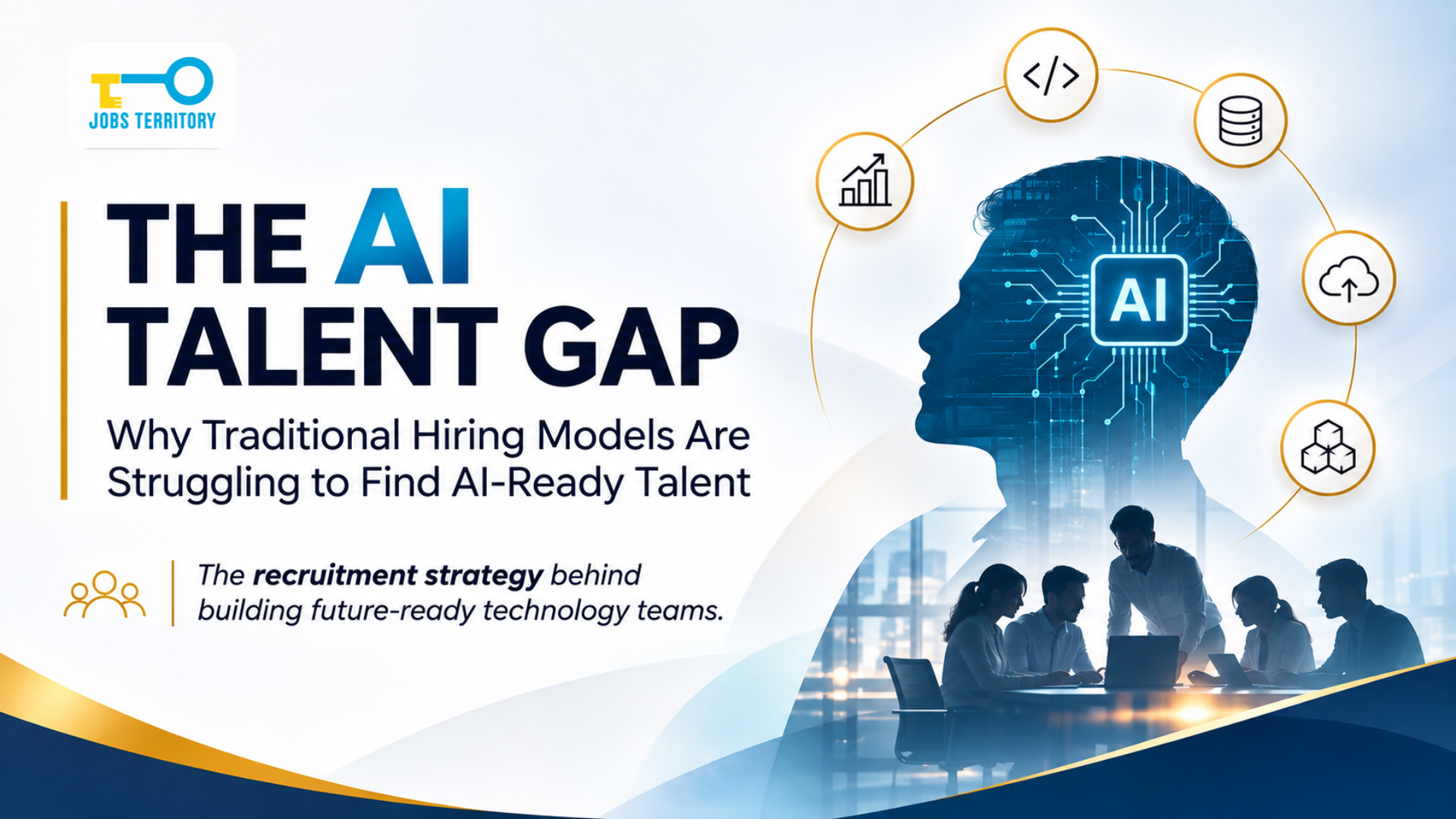
The challenge isn't just finding AI professionals. It's finding the right technical capabilities for the right business requirements.
Artificial Intelligence is changing how businesses build products, manage operations and compete in the market.
As organisations accelerate AI adoption, demand for specialised technology professionals is growing. Companies are looking for AI/ML Engineers, Data Scientists, MLOps Engineers, AI Solutions Architects and professionals who can integrate AI into real business environments.
Yet, many organisations continue to face a common recruitment challenge: finding candidates whose technical capabilities genuinely match their requirements.
For Founders, CTOs and CHROs, this raises an important question:
Are traditional hiring strategies equipped to identify the next generation of technology talent?
At Jobs Territory, we believe the challenge goes beyond talent availability. It also lies in how organisations define roles, source candidates and evaluate technical capabilities.
1. The AI Talent Gap Is Also a Recruitment Gap
The technology talent market is evolving faster than many traditional recruitment processes.
A company looking for an AI professional may receive hundreds of applications, but only a small proportion may have the practical experience required for the role.
Why does this happen?
Because AI-related job titles often cover very different skill sets.
For example:
- An AI/ML Engineer develops and implements machine learning models.
- An MLOps Engineer focuses on deploying, monitoring and maintaining machine learning systems.
- A Data Scientist analyses data and develops predictive models.
- An AI Solutions Architect designs AI-powered systems aligned with business requirements.
- An LLM Engineer works on applications involving large language models, retrieval-augmented generation and related technologies.
Treating these roles as interchangeable can lead to mismatched hiring decisions.
The first step towards better technology recruitment is understanding exactly what the business needs.
2. Why Traditional Hiring Models Are Falling Short
Many organisations still rely on recruitment methods designed around conventional job roles.
However, specialised technology hiring requires a more focused approach.
A. Overdependence on Job Titles
A candidate's previous designation does not always reflect their actual technical capabilities.
Two professionals with the same job title may have entirely different responsibilities, technology exposure and levels of expertise.
Recruiters and hiring managers must look beyond designations and understand the candidate's actual project experience.
B. Keyword-Based Resume Screening
Matching resumes against technical keywords can help identify potential candidates, but it cannot establish whether someone has practical experience with those technologies.
Mentioning Python, machine learning or generative AI on a resume does not automatically demonstrate the ability to build and deploy production-ready solutions.
C. Unclear Job Requirements
Sometimes, organisations begin hiring without clearly defining the technical expectations.
For example, a company may request an AI Engineer but leave important questions unanswered:
- Is experience in model development essential?
- Is production deployment required?
- Is cloud-based AI experience necessary?
- Does the role require LLM application development?
- What business problem will this professional solve?
Without clarity, recruitment teams risk sourcing candidates who look suitable on paper but do not match the actual requirement.
D. Overemphasis on Years of Experience
Technology evolves rapidly. A candidate's ability to work with relevant tools, solve problems and demonstrate practical knowledge can be more valuable than years of experience alone.
Recruitment strategies should consider technical depth, project exposure and learning agility.
3. The Specialised Skills Businesses Should Be Hiring For
Instead of approaching AI recruitment as one broad category, organisations should identify the specific capabilities required.
Some important technology talent segments include:
- AI & Machine Learning: Python, machine learning frameworks and model development.
- Data Science: Statistical modelling, data analytics and predictive modelling.
- MLOps: Model deployment, monitoring and automation.
- Generative AI: Large Language Models (LLMs), Retrieval-Augmented Generation (RAG), prompt engineering and AI application development.
- Cloud & AI Infrastructure: AWS, Microsoft Azure, Google Cloud Platform (GCP) and scalable AI infrastructure.
- Data Engineering: Data pipelines, data architecture and data platforms.
The right combination depends on the organisation's technology roadmap, project requirements and business objectives.
4. Five Recruitment Strategies to Find the Right AI Talent
Finding specialised technology professionals requires more than posting a job opening and waiting for applications.
Here are five ways organisations can strengthen their recruitment approach.
1. Build Skill-Based Job Descriptions
Define the technical capabilities required rather than relying on broad job titles.
Separate essential skills from desirable skills to avoid unnecessarily restricting the candidate pool.
2. Focus on Targeted Talent Sourcing
Explore relevant talent communities, professional networks, technology ecosystems and passive candidate pools.
A targeted sourcing strategy can help identify professionals who may not be actively applying for jobs.
3. Evaluate Practical Technical Experience
Look beyond resume keywords.
Review relevant projects, implementation experience, technical problem-solving and the candidate's ability to explain their work.
Use role-specific technical assessments in collaboration with qualified technical interviewers.
4. Improve Hiring Manager and Recruiter Alignment
Recruiters and technical hiring managers should agree on the role requirements before sourcing begins.
Clear communication around responsibilities, technical expectations and evaluation criteria can reduce unnecessary interview rounds and mismatched shortlists.
5. Build Long-Term Technology Talent Pipelines
Do not wait until a critical vacancy becomes urgent.
Maintain relationships with relevant professionals and map talent pools for recurring or future technology requirements.
This can support more proactive workforce planning.
5. Why Specialised Technology Recruitment Requires the Right Recruitment Partner
Specialised technology recruitment is not simply about collecting resumes that contain the right technical keywords.
It requires an understanding of:
- The difference between closely related technical roles.
- The skills required for specific technology environments.
- Relevant candidate backgrounds and project exposure.
- The availability of specialised talent in the market.
- The alignment between candidate capabilities and business requirements.
A recruitment partner with a structured sourcing and screening approach can help organisations navigate these challenges.
At Jobs Territory, our focus is on understanding client requirements, identifying relevant talent pools and connecting organisations with professionals aligned with their hiring needs.
Our end-to-end recruitment approach supports businesses across industries, including organisations looking to strengthen specialised technology teams.
6. The Future of Technology Hiring Starts With Better Recruitment Decisions
AI adoption will continue to change the technical capabilities organisations need.
But hiring the right professionals will require more than simply updating job descriptions or adding AI-related keywords to recruitment searches.
Businesses need to rethink how they define technical roles, identify talent, assess capabilities and build long-term recruitment strategies.
The organisations that approach specialised technology hiring strategically will be better positioned to build teams aligned with their business goals.
The question is no longer just how quickly you can hire technology talent. It is whether you are identifying the right capabilities for the work ahead.
Building Your Next Technology Team?
Whether you are hiring AI/ML Engineers, Data Scientists, Cloud Specialists or other specialised technology professionals, Jobs Territory can support your recruitment requirements.
Let's connect and discuss your talent needs.
Website: https://jobsterritory.com
Email: careers@jobsterritory.com
More articles