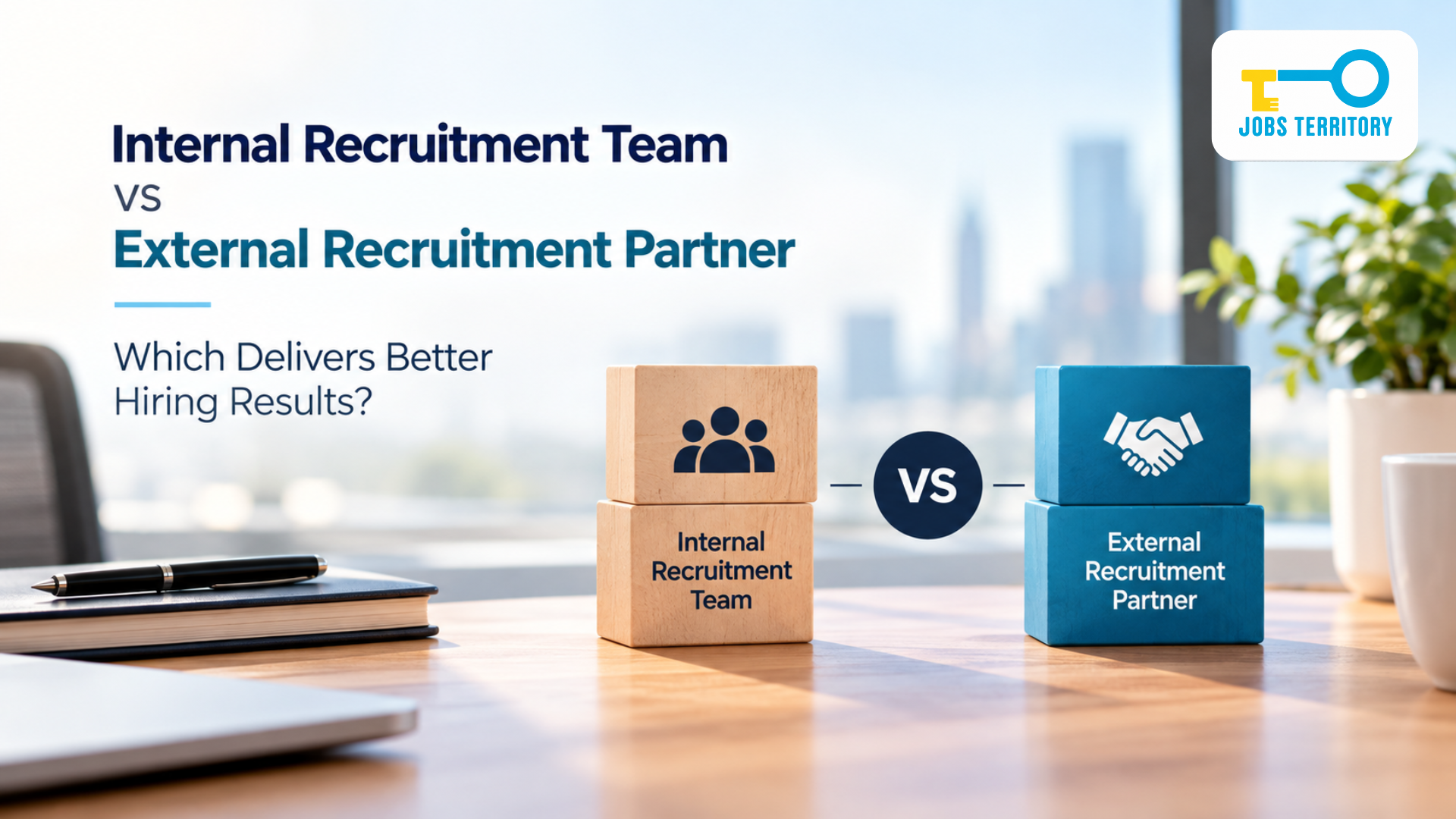
Internal Recruitment Team vs External Recruitment Partner: Which Delivers Better Hiring Results?
Hiring the right talent is more than an HR responsibility. It directly influences business growth, team productivity, and organisational performance.
For startups and established enterprises, one important question is: Should you rely on your internal recruitment team, work with an external recruitment partner, or combine both?
The answer depends on your hiring requirements, team capacity, role complexity, and business priorities.
1. Understanding Internal Recruitment Teams
An internal recruitment team understands the company's culture, business goals, and hiring expectations. It typically manages job postings, candidate sourcing, screening, interviews, and coordination with hiring managers.
For regular hiring and long-term workforce planning, an internal team can provide continuity and strong alignment with the organisation.
However, when multiple vacancies arise simultaneously or specialised roles become difficult to fill, the team's existing workload may limit its capacity to manage every requirement.
2. How External Recruitment Partners Add Value
An external recruitment partner provides additional recruitment support based on the company's agreed requirements.
This can be useful when a business needs specialised talent, has multiple open positions, faces sourcing challenges, or requires additional recruitment capacity without immediately expanding its internal team.
A recruitment partner may support candidate sourcing, screening, shortlist preparation, and interview coordination, depending on the agreed scope.
However, successful hiring also depends on candidate availability, compensation, employer expectations, and timely decisions from the hiring team. Engaging an external partner does not automatically guarantee faster results.
3. Internal vs External Recruitment: A Practical Comparison
The key differences can be summarised across six factors:
- Company knowledge: Internal teams usually have established organisational context, while external partners need a clear briefing.
- Sourcing capability: Internal sourcing depends on existing expertise and networks; an external partner may add specialised sourcing capabilities.
- Hiring capacity: Internal capacity depends on team size and workload, while external support can help manage agreed additional requirements.
- Cost structure: Internal recruitment involves salaries, tools, technology, and overheads. External recruitment involves agreed fees and engagement costs.
- Process ownership: Internal teams are embedded within the organisation, while external responsibilities depend on the engagement scope.
- Best suited for: Internal teams often manage ongoing hiring, while external partners can support specialised, difficult, urgent, or additional requirements.
Neither approach is universally better. The right choice depends on the organisation's specific needs.
4. Why a Hybrid Recruitment Strategy Can Work
Many businesses can benefit from combining internal recruitment with external support.
For example, an internal HR team may manage regular hiring while an external recruitment partner focuses on specialised positions or additional vacancies.
This approach allows the company to retain internal ownership while accessing extra recruitment support when needed.
Clear communication, defined responsibilities, agreed timelines, and transparent commercial terms are essential to making this partnership work effectively.
5. What Should Businesses Look for in a Recruitment Partner?
Choosing a recruitment partner involves more than comparing fees or the number of resumes received.
Businesses should evaluate whether the partner:
- Understands the role and business requirements.
- Has relevant recruitment experience.
- Focuses on candidate suitability.
- Communicates progress and feedback clearly.
- Offers transparent commercial terms and defined responsibilities.
Recruitment success should also be evaluated through meaningful measures such as shortlist quality, time to fill, offer acceptance, joining outcomes, and hiring manager feedback.
6. How Jobs Territory Supports Business Hiring
At Jobs Territory, we understand that every organisation has different recruitment requirements.
Startups may need support while building their teams, while established businesses may require assistance with specialised roles or multiple vacancies.
We provide end-to-end recruitment support across industries, based on agreed hiring requirements. Our approach focuses on understanding the role, aligning candidate sourcing with business needs, and coordinating with clients throughout the agreed recruitment process.
Our goal is to build recruitment partnerships around each organisation's needs rather than follow a one-size-fits-all approach.
Conclusion: Choose the Right Recruitment Approach for Your Business
Internal recruitment teams and external recruitment partners can complement each other. Internal teams bring organisational knowledge and continuity, while external partners may add sourcing expertise and capacity for selected hiring requirements.
The key is to identify what your business needs, where your existing recruitment capabilities are sufficient, and when additional support could be valuable.
Planning new hires or struggling to fill a critical position?
Connect with Jobs Territory to discuss your hiring requirements and explore how our recruitment services may support your business.
Jobs Territory — The Right Talent. The Right Recruitment Partner.
Website: https://jobsterritory.com
Email: careers@jobsterritory.com
More articles