Why GCCs in India Are Struggling to Hire AI Talent (and What Actually Fixes It)
Why GCCs in India Are Struggling to Hire AI Talent (and What Actually Fixes It)
India's Global Capability Centres are not short of ambition. India has roughly 1,850–1,900 active GCCs, with a workforce expected to be close to 2.5 million professionals. Budgets are approved and mandates are clear. The roles still stay open for months.
The problem is not a lack of intent. It is a mismatch between what GCCs want to hire and how they go about hiring it.
1. Where the skill gap really sits
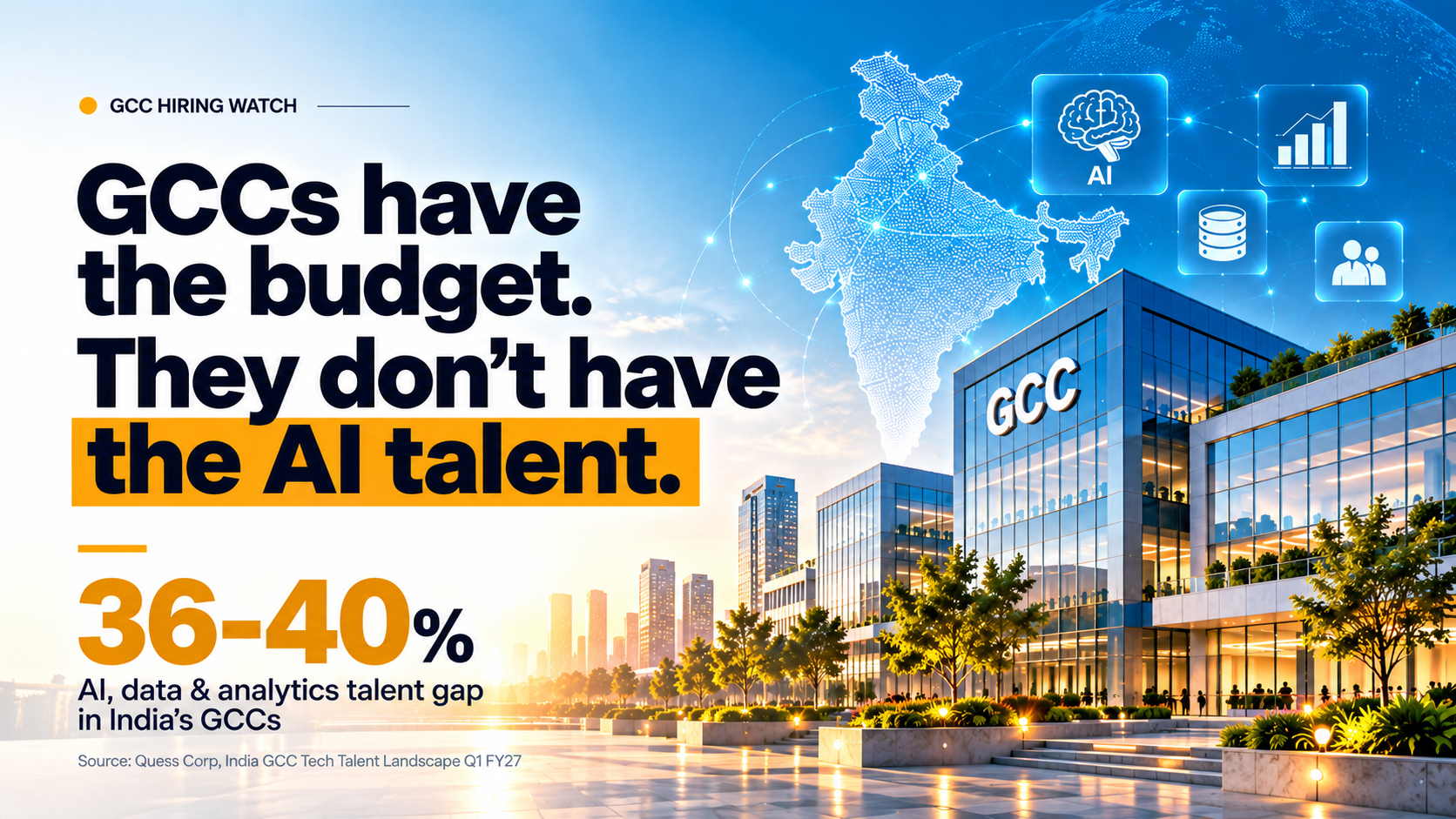
The latest Quess Corp GCC talent report puts the AI, data and analytics supply-demand gap at 36–40%, followed by platform engineering at 32–36%. The gap is not even across the board. Earlier reports flagged the hardest-to-fill clusters as GenAI engineering, MLOps pipelines, AI observability, Terraform, Kubernetes and hybrid-cloud reliability.
The pattern is clear. Many people can build a model in a notebook. Far fewer can run it in production, which means monitoring it, scaling it and keeping it reliable. The scarce profile is the one with production discipline, not the one with a good demo.
Experience level makes it harder. Professionals with four to 12 years of experience account for nearly 56% of GCC hiring demand. That is exactly the mid-senior band where supply is thinnest.
Location adds another layer. Earlier data showed that limited mid-senior talent availability means nearly 50% of complex roles in Tier-1 cities are being redirected back to Tier-1 hubs. Moving a role to a Tier-2 city does not solve the shortage.
2. The hiring mistakes that make it worse
The market is tight, but many GCCs also make it harder for themselves. These are the three mistakes we see most often:
Vague JDs. "AI/ML Engineer, 5+ years, Python" attracts every kind of profile and filters none. Is the role about LLM applications, classical ML, data platforms or MLOps? A candidate who cannot tell what the job actually is will not apply, or will apply for everything.
Unrealistic stacks. Some JDs ask for GenAI, MLOps, cloud architecture, data engineering and stakeholder management in one person. That person barely exists. Companies end up waiting for a unicorn while good candidates with 70% of the stack, who could learn the rest, go to a faster competitor.
Slow processes. Strong AI candidates are rarely on the market for long. Four interview rounds spread over six weeks, with slow feedback, means the offer goes out after the candidate has already signed elsewhere.
3. What actually fixes it
The fixes are not complicated, but they need discipline.
- Define the role before the search. Write the problem the person will solve in their first six months, then derive the must-have skills from it. Separate the three or four non-negotiables from the nice-to-haves.
- Hire for adjacent skills. The market is already moving this way. GCCs are increasingly building AI capability by reskilling existing employees from adjacent technology roles instead of relying only on external hiring. The same logic applies to outside hires. A strong data or backend engineer with the right foundation can often grow into an AI role faster than a perfect-fit profile can be found.
- Compress the process. Fewer rounds, clear owners, and feedback within 48 hours. Speed is a competitive advantage in a candidate-driven market.
- Widen the geography. Look beyond one city. Tier II cities such as Coimbatore, Ahmedabad and Kochi already account for 11–13% of hiring demand. The talent is spreading, and so should your search.
Where a recruitment partner fits in
A specialist partner does not magically create talent. What a good one does is shorten the distance between a real problem and the right person.
At Jobs Territory, our focus is AI and technology hiring in India. In practice that means:
- Sharpening the brief with hiring managers before sourcing begins, so the search targets the right profile.
- Reaching passive talent who will never see a job post but will respond to a relevant, well-explained conversation.
- Screening for real capability, not just keywords, so your team's interview time goes to serious candidates.
- Keeping the process moving, so strong candidates do not drop out while waiting.
The GCCs that win the AI talent race will not be the ones with the biggest budgets. They will be the ones that hire with clarity, move fast and look beyond the obvious profile.
Building an AI or tech team in India? Talk to us: careers@jobsterritory.com
More articles