When Should a Growing Company Partner with a Recruitment Agency?
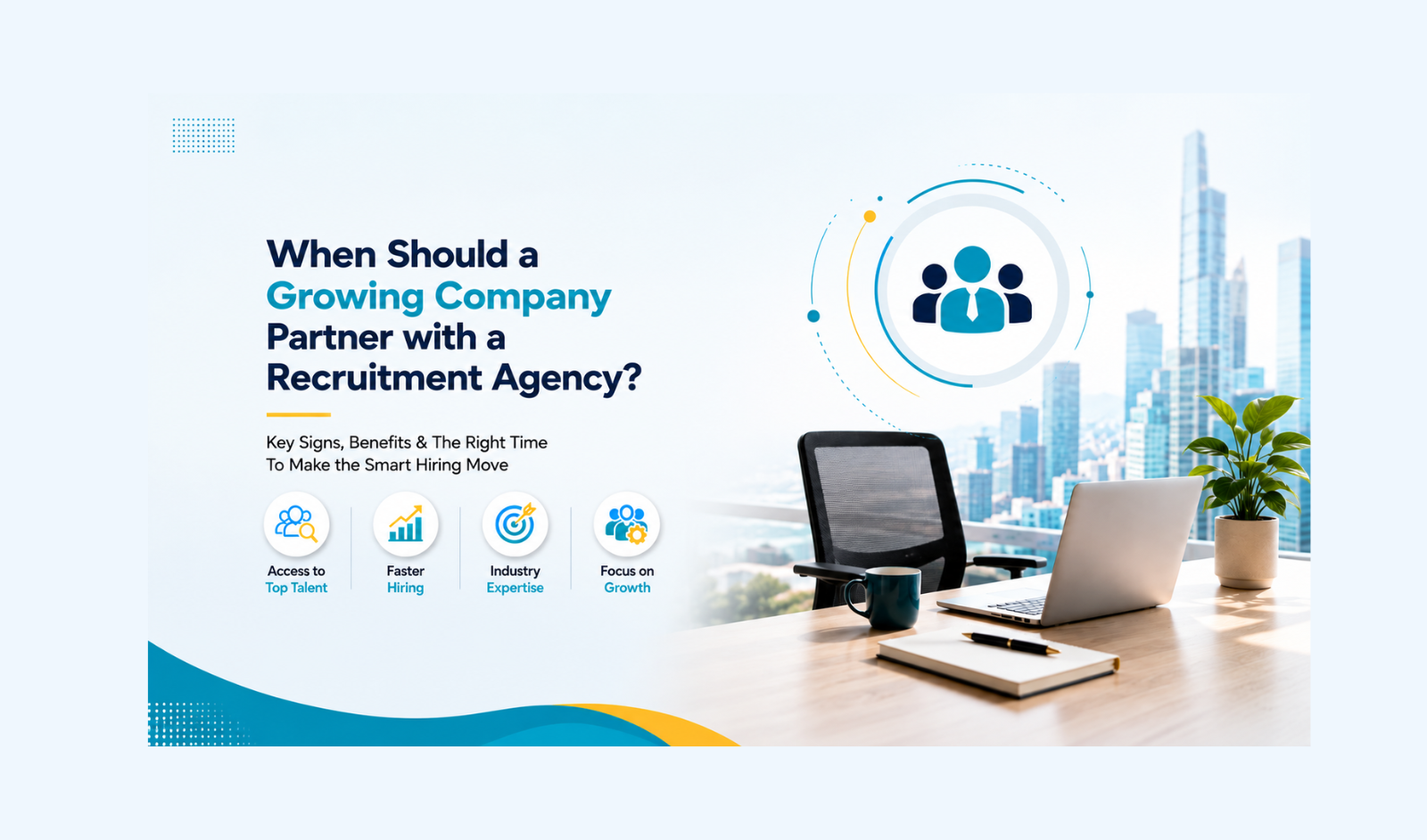
When Should a Growing Company Partner with a Recruitment Agency?
Growth is exciting.
New clients are coming in. Business is expanding. Teams are getting bigger. New roles are being created.
But there is one challenge that often grows alongside the business: hiring the right people at the right time.
For a small company, hiring may initially be manageable through referrals, job portals, LinkedIn, and an internal HR team. But as hiring volumes increase and roles become more specialized, recruitment can quickly become a time-consuming process.
This raises an important question for founders, CEOs, and HR leaders:
When does it make sense to partner with a recruitment agency?
The answer isn't simply, “When we have too many vacancies.”
A recruitment partner becomes valuable when hiring starts affecting business speed, internal productivity, candidate quality, or the ability to access specialized talent.
Here are some situations where a growing company should seriously consider external recruitment support.
1. When Your Hiring Volume Suddenly Increases
One of the clearest signs is a rapid increase in hiring requirements.
A company may go from hiring two or three employees a month to needing 10, 20, or more employees within a short period.
At that point, internal HR teams can become overwhelmed with:
- Candidate sourcing
- Resume screening
- Interview coordination
- Candidate follow-ups
- Maintaining recruitment pipelines
- Communicating with hiring managers
The challenge isn't necessarily that the HR team isn't capable.
The challenge is capacity.
A recruitment agency can act as an extension of the internal HR team, providing additional sourcing and screening support while the company focuses on selecting the right candidates.
A recruitment agency can act as an extension of the internal HR team, providing additional sourcing and screening support while the company focuses on selecting the right candidates.
2. When You Need to Hire for Specialized Roles
Not every position can be filled effectively through general job portals.
As companies grow, they often need professionals with highly specific technical, functional, or industry experience.
Examples include:
- Senior technology professionals
- Engineering specialists
- Finance leadership
- Healthcare professionals
- Sales leadership
- GCC and specialized corporate roles
- Industry-specific technical talent
For these positions, the challenge isn't simply finding a candidate.
It's finding someone with the right combination of skills, experience, availability, and cultural fit.
A specialized recruitment partner can help companies reach candidates who may not be actively applying but could be interested in the right opportunity.
3. When Critical Positions Remain Vacant for Too Long
An open position isn't just an HR problem.
For a growing company, a critical vacancy can affect:
Productivity → Team workload → Business delivery → Revenue
For example, an unfilled sales leadership position could affect revenue growth, while a vacant technical role could delay product development.
If important positions repeatedly remain open for extended periods, it may be time to evaluate whether additional recruitment expertise is needed.
4. When Your Internal HR Team Is Spending Too Much Time Sourcing
HR teams have responsibilities beyond recruitment.
They may also manage:
- Employee engagement
- Performance management
- Policies
- Employee relations
- Learning and development
- Compliance
- People strategy
When HR professionals spend most of their time searching resumes and coordinating initial screening, strategic HR activities can take a back seat.
A recruitment partner can take ownership of parts of the hiring funnel, allowing the internal HR team to focus on people strategy rather than recruitment administration.
5. When You Need to Scale Quickly
Some hiring situations are predictable.
Others aren't.
A new project may require an entire team. A major client may suddenly increase requirements. A company may enter a new market or launch a new business unit.
In these situations, hiring needs can change dramatically within weeks.
A recruitment agency can provide additional sourcing capacity when companies need to scale their teams quickly without permanently expanding their internal recruitment infrastructure.
6. When Your Company Is Entering a New Market
Entering a new city, state, country, or business segment creates another recruitment challenge:
You may not know the local talent market well enough.
Questions quickly arise:
- Where is the relevant talent located?
- What are the current salary expectations?
- Which skills are difficult to find?
- How competitive is the market?
- Which hiring channels work best?
A recruitment partner with relevant market knowledge can help companies understand the talent landscape and develop a more effective hiring strategy.
7. When You Need Access to a Larger Talent Network
Posting a vacancy and waiting for applications is only one approach to recruitment.
For certain positions, companies need a more proactive strategy:
Talent Mapping → Candidate Sourcing → Outreach → Screening → Shortlisting
A recruitment agency can expand the company's reach beyond candidates who are actively looking for jobs.
This becomes particularly valuable for 7. When You Need Access to a Larger Talent Network
Posting a vacancy and waiting for applications is only one approach to recruitment.
For certain positions, companies need a more proactive strategy:
Talent Mapping → Candidate Sourcing → Outreach → Screening → Shortlisting
A recruitment agency can expand the company's reach beyond candidates who are actively looking for jobs.
This becomes particularly valuable for senior, niche, and difficult-to-fill positions.
8. When Bad Hires Are Becoming Expensive
Hiring quickly isn't the same as hiring effectively.
A poor hiring decision can cost a company through:
- Lost productivity
- Recruitment costs
- Training time
- Team disruption
- Delayed projects
- Employee turnover
As a company grows, the cost of a wrong hire can become significantly higher.
That's why recruitment should focus not only on filling positions, but also on improving the quality of the hiring decision.
9. When Your Business Is Growing Faster Than Your Recruitment Infrastructure
This may be the biggest signal of all.
Your business may have evolved significantly, but your recruitment process may still look the same as it did when the company was smaller.
If you're experiencing:
- Too many open positions
- Slow hiring cycles
- Limited candidate pipelines
- Increasing recruitment workload
- Difficulty finding specialized talent
- Hiring managers constantly following up on recruitment
then your recruitment infrastructure may no longer match your company's growth.
That's when external recruitment support can become a strategic advantage.
Should Every Growing Company Use a Recruitment Agency?
No.
A recruitment agency isn't automatically the right solution for every vacancy.
If your company has a strong internal recruitment team, predictable hiring requirements, an established talent pipeline, and sufficient sourcing capacity, internal hiring may work perfectly well.
The better question is:
Where would external recruitment expertise create the most value for our business?
For some companies, that may mean outsourcing the entire recruitment process.
For others, it could simply mean using an agency for specialized, urgent, senior, or high-volume hiring.
Recruitment Agency vs. Internal Hiring: Does It Have to Be Either/Or?
Not necessarily.
In many cases, the strongest approach is both.
Your internal HR team understands your:
- Company culture
- Business objectives
- Teams
- Internal processes
- Long-term people strategy
A recruitment agency can add:
- Additional sourcing capacity
- Specialized talent networks
- Market reach
- Candidate screening
- Recruitment expertise
- Faster access to talent
Together, they can create a stronger and more scalable recruitment process.
The Real Question: Can Hiring Keep Up With Growth?
For founders, CEOs, and HR leaders, recruitment is ultimately a business-growth question.
If you have ambitious growth plans but cannot hire the people required to execute them, recruitment becomes a bottleneck.
And when hiring becomes a bottleneck, growth can slow down.
The right recruitment partner doesn't simply send resumes.
A strong partner should understand the role, the business requirement, the talent market, and the kind of candidate who can contribute to long-term success.
Final Thought
Growth creates opportunities—but people create growth.
If your company is expanding faster than your recruitment process can handle, it may be time to bring in additional expertise.
The right recruitment partnership can help your business spend less time searching, reach better talent, and give your internal team more time to focus on what matters most:
Building the business.
Is your hiring strategy ready for your next stage of growth?
If you're facing increasing hiring demands, specialized talent requirements, or recruitment bottlenecks, exploring the right recruitment support could be the next step.
Connect With Jobs Territory
Jobs Territory helps businesses connect with the right talent and build stronger teams through focused recruitment solutions.
Follow Jobs Territory for recruitment insights, hiring trends, and talent strategies.
LinkedIn: Jobs Territory
Instagram: @jobsterritory
Email: careers@jobsterritory.com
Website: www.jobsterritory.com
Ready to make your next hire count?
Connect with Jobs Territory and discuss your hiring requirements.
More articles